

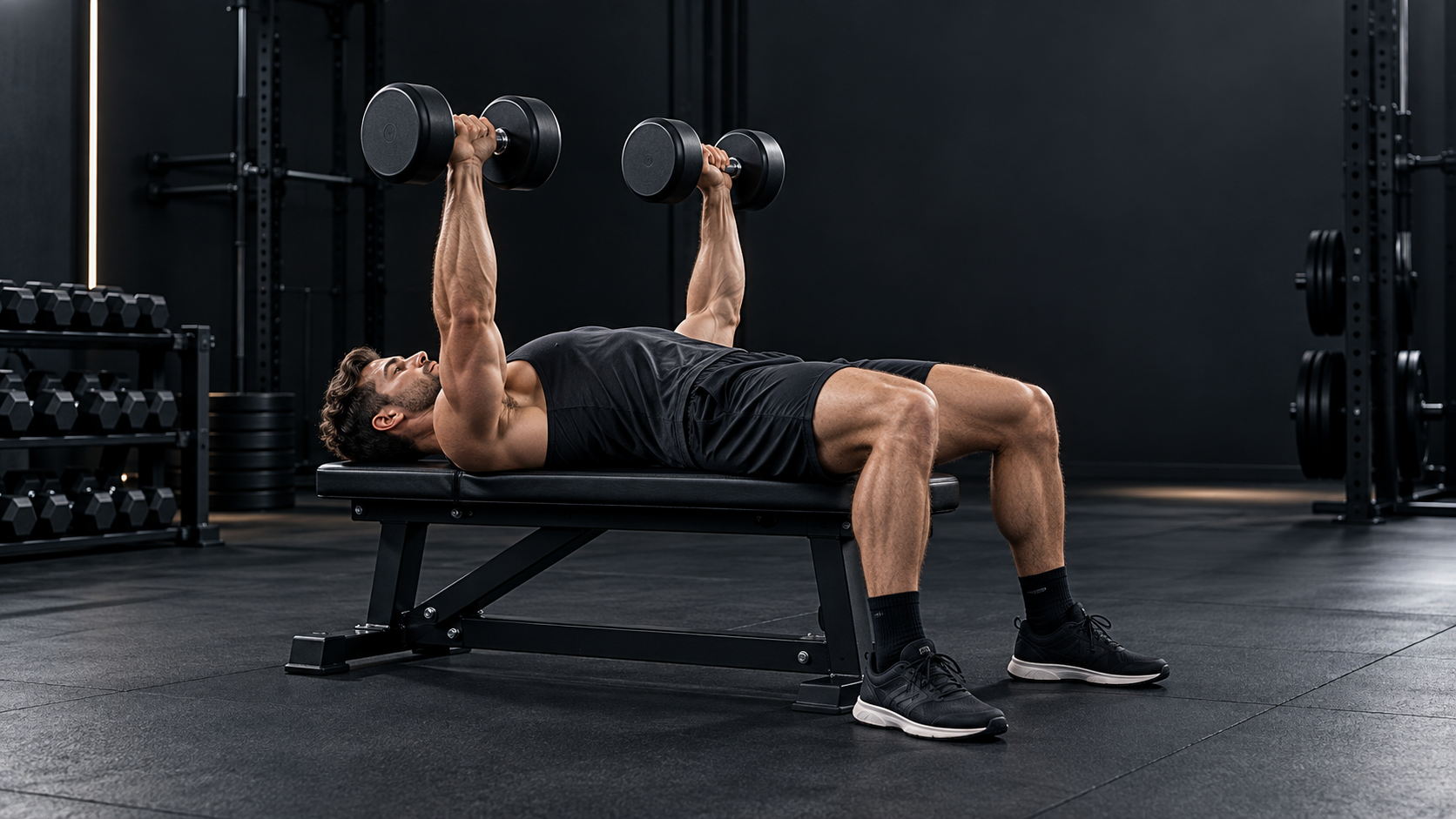
The flat dumbbell bench press is a pressing accessory performed lying on a flat bench, pressing a dumbbell in each hand up from chest level to full arm extension. Compared to the barbell bench press, it allows a greater range of motion and lets each arm work independently, which helps build chest, shoulder, and triceps strength and correct side-to-side imbalances. It's often programmed for higher reps than the competition bench press, as supplementary volume rather than a maximal-effort lift.
Technique: set up the same way as the barbell version — shoulder blades retracted, feet planted — but bring the dumbbells to roughly chest level with the elbows at about 45-75 degrees from the torso rather than flared to 90, then press them up and slightly together until the arms are extended, without letting the dumbbells touch overhead.
Common technical errors: letting the elbows flare out too wide, placing extra strain on the shoulders; lowering the dumbbells unevenly between the two arms; losing control of the dumbbells at the bottom of the movement, which can strain the shoulder joint; and pressing with momentum rather than a controlled tempo.