

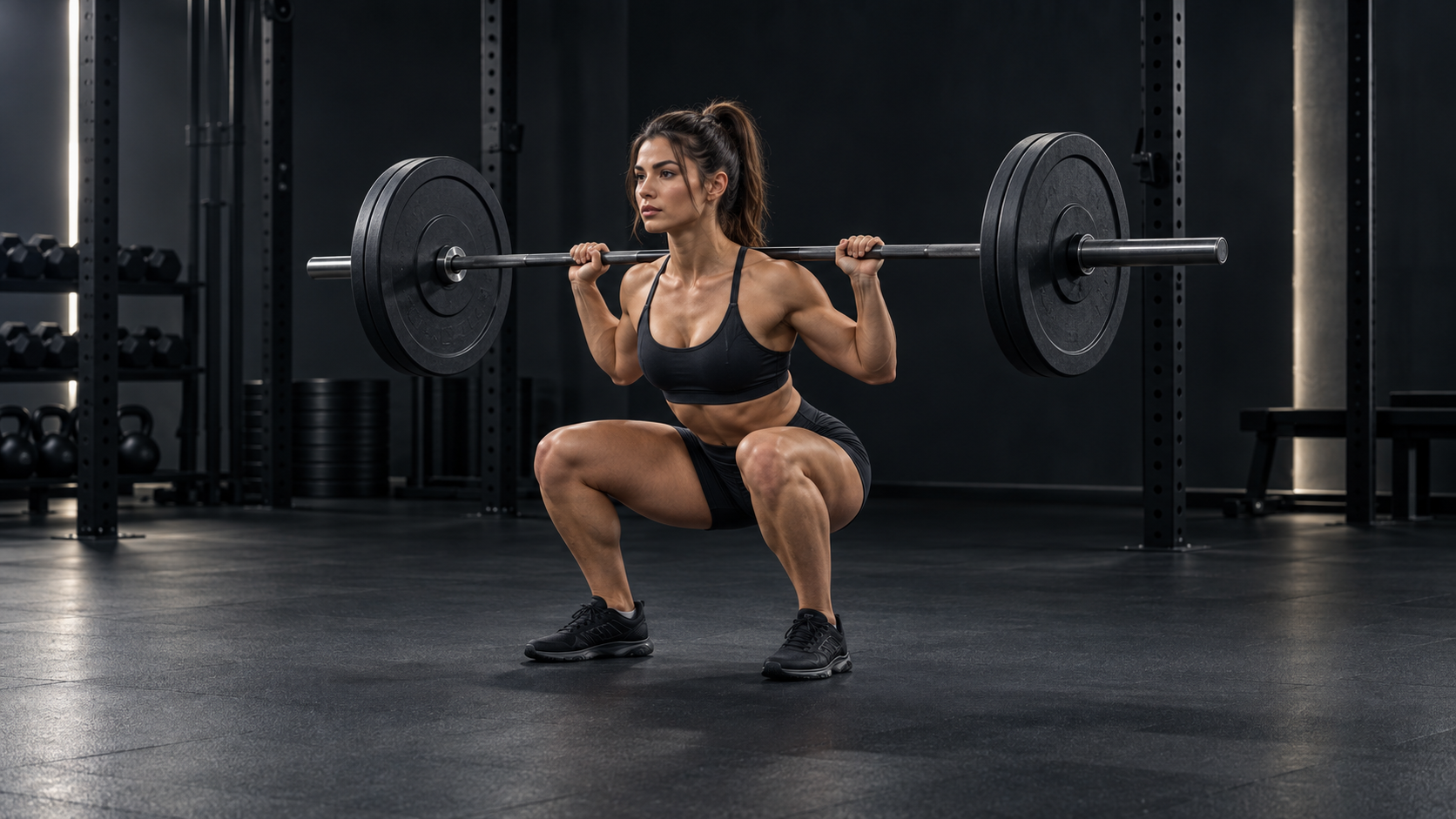
The back squat is the foundational squat variant in powerlifting: the barbell rests across the upper back (traps/rear delts) while you bend the knees and hips to lower into a squat, then drive back up to standing. It builds strength and size in the quadriceps, glutes, and hamstrings, and also trains the core and upper back as stabilizers. As one of the three competition lifts, it's the main lower-body movement in most strength programs.
Technique: the bar sits either high on the traps (high-bar) or lower across the rear delts (low-bar) — the exact position affects how upright the torso stays, but isn't itself prescribed here as one fixed standard. Feet are set roughly shoulder-width or slightly wider, toes turned out a little. The descent starts by bending the hips and knees together (not just the knees), keeping the chest up and a neutral spine, until the depth set by the program and the lifter's mobility is reached. The ascent drives through the whole foot, extending hips and knees back to standing. How deep the squat is taken is generally set by the program's requirements and the lifter's hip and ankle mobility, rather than one fixed universal depth.
Common technical errors: the knees caving inward (valgus) as the weight gets heavier; the heels lifting off the floor or weight shifting onto the toes; losing a neutral spine by rounding the lower back at the bottom of the descent; and the hips rising faster than the chest out of the bottom ("good morning" squat), which shifts load away from the legs and onto the lower back.