
In everyday speech, "stress" can mean school overload, anxiety, tiredness and the body's response to a threat. In research these are different constructs.
Subjective stress reflects a person's own appraisal of a demand and of their ability to cope with it. Anxiety and depressive symptoms may accompany stress but have their own causes and diagnostic criteria. Cortisol is linked to the hypothalamic–pituitary–adrenal axis, while heart rate, blood pressure and heart rate variability describe different aspects of cardiovascular and autonomic regulation.
None of these measures is a universal "stress sensor". A child may feel better without a noticeable change in cortisol — or show a physiological change without subjective improvement.
Chen and colleagues systematically gathered studies of physical interventions in typically developing children and adolescents. They analysed psychological and physiological outcomes separately and rated the certainty of evidence with GRADE.
The programmes differed greatly: aerobic, strength, mixed and mind–body practices, with different intensity, frequency, duration and settings. Some studies compared against no programme, others against an active control. This makes it hard to say which exact load suits which child.
For perceived or overall stress, a possible small average reduction was found. For depressive symptoms the estimate was larger but showed extremely high heterogeneity and depended on the statistical method and on individual studies. In both cases the certainty of evidence was very low.
For anxiety and fatigue, no statistically convincing average effect was found. This does not mean exercise helps no one. The number of studies was limited, programmes and scales differed, and individual response could depend on baseline state, autonomy, social context and recovery.
A separate 2026 meta-analysis on a single exercise session and anxiety in children and adolescents reported a short-term reduction in anxiety, but with very high heterogeneity. The effect of a single session cannot be equated with long-term treatment of an anxiety disorder.
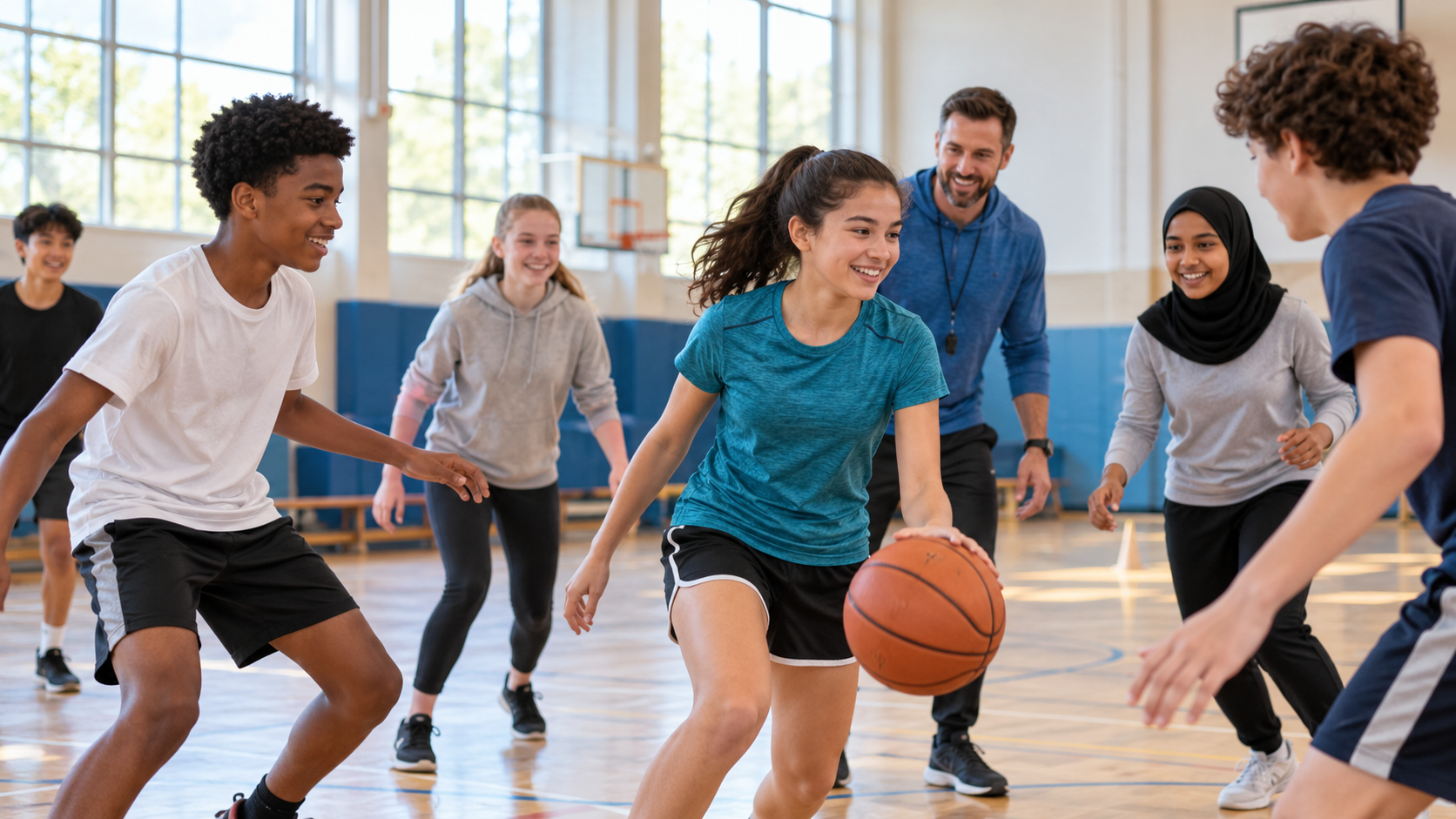
As an example of an individual intervention, Niu and colleagues assigned four school classes — 144 children aged 10–11 — to either an interactive programme of basketball and football or a more individual programme of athletics and gymnastics. After 16 weeks both groups reported less psychological stress, and the interactive programme produced a larger reduction. But there were only four classes, no passive control, and the outcome was self-reported in a single school; the study therefore does not establish a universal effect of team games.
The authors found low-certainty evidence of a possible small reduction in systolic blood pressure. For diastolic pressure and the LF/HF ratio of heart rate variability, certainty was very low.
No convincing average differences were seen for resting heart rate, cortisol, RMSSD and SDNN. It is particularly important that the pooled category "blood cortisol" did not always separate serum from plasma and does not allow the result to be transferred to salivary cortisol.
Physiological measurements were often taken at rest. They do not necessarily show how a child reacts to a particular stressor and how quickly they recover from it.
The age range from childhood to late adolescence covers different stages of development. School demands, family environment, sleep, nutrition, chronic illness and social support can influence the outcome more than a single training programme.
The format of sessions also matters. Voluntary play with friends, a competitive club with high pressure and compulsory school exercise can last the same time yet have completely different psychological meaning. Increasing training without recovery can add fatigue instead of helping.
Physical activity can be one part of support, but it does not replace psychotherapy, medical assessment or changing an unsafe environment.
The strengths of the review are that it keeps psychological scales and physiological measures distinct and uses risk-of-bias tools and GRADE. The limitations are the small number of studies for some outcomes, small samples, unequal protocols, high statistical heterogeneity, different measurement instruments and the absence of reliable long-term data.
Physical activity may help some children and adolescents feel less stressed, but the average effect is not guaranteed and does not extend automatically to anxiety, depressive disorder or hormonal measures. The most accurate wording today is that movement is a promising element of support, whose quality and dose should take into account the child, the context and recovery.