
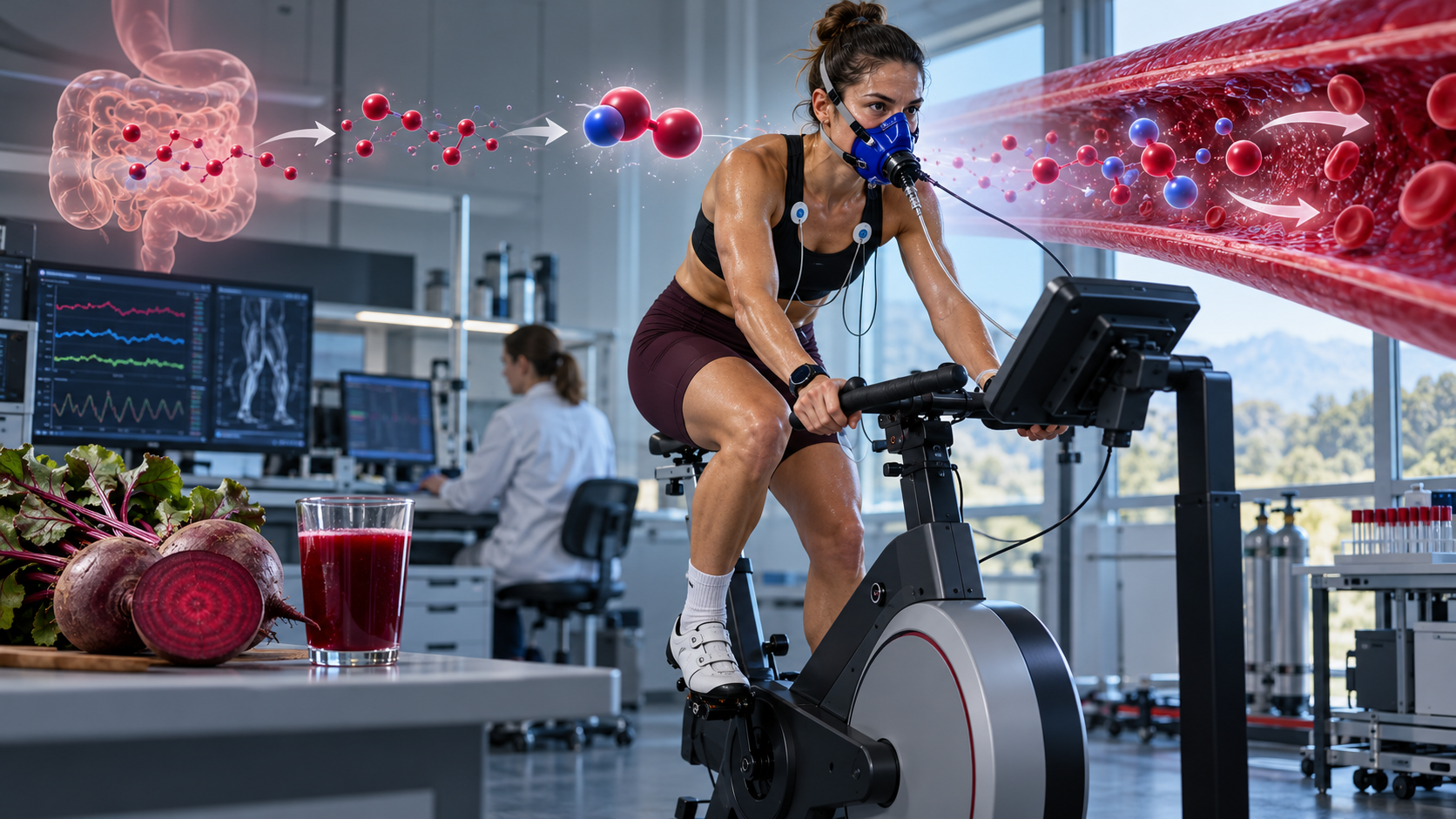
Beetroot is rich in inorganic nitrate. After it is consumed, part of the nitrate is converted by bacteria in the mouth into nitrite and then, especially under low oxygen and more acidic conditions, into nitric oxide. Nitric oxide takes part in regulating vascular tone, blood flow, mitochondrial function and muscle contraction.
The mechanism looks convincing, but biological plausibility does not guarantee a better sporting result. Between a change in a molecular pathway and seconds gained lie technique, training status, the type of test, diet, sleep, dose and individual response.
The 2025 umbrella review by Poon and colleagues included 20 meta-analyses, 180 primary studies and 2,672 unique participants. It found improvements in time to exhaustion, muscular endurance, peak power and some other outcomes, but not in all measures. The methodological quality of most of the included reviews was rated low or critically low.
An important difference is the make-up of the sample. If untrained, recreationally active and elite participants are pooled, the average effect may mainly reflect people with lower baseline aerobic fitness. In a well-trained athlete, baseline nitric oxide availability and physiological adaptations may already be higher, so extra nitrate may add less.
An instructive primary experiment by Boorsma and colleagues involved eight elite male 1500 m runners. In a double-blind crossover study, neither a single dose nor eight days of beetroot juice loading improved the group's 1500 m time or reduced oxygen uptake during submaximal running. Two participants did show a personal improvement — an interesting observation which, because the sample was extremely small, does not prove that a reproducible category of "responders" exists.
The new systematic review focused on athletes. The authors included 45 randomised, placebo-controlled trials with 659 participants: 556 men, 88 women and 15 people whose sex was not explicitly stated. Only three trials included women exclusively, so confident conclusions by sex are not possible.
The sports ranged from running, cycling and triathlon to rowing, swimming, team games, combat sports and CrossFit. Twenty-nine studies used a single dose and 16 used loading for three to eight days. Daily doses ranged roughly from 4 to 19.35 mmol of nitrate.
The authors analysed six outcomes separately:
These measures cannot be folded into one general label such as "endurance". VO₂max describes maximal cardiorespiratory capacity, power describes the result of a particular test, and heart rate, lactate and perceived exertion are responses to a workload rather than a win in competition.
For none of the six outcomes did the overall effect reach statistical significance. The estimates were small and the 95% confidence intervals crossed zero. For VO₂max and heart rate the authors rated the certainty of evidence as moderate, for peak and mean power as low, and for lactate and perceived exertion as very low.
In studies including only men, a small positive result appeared for peak power. However, the difference from mixed-sex studies was not statistically confirmed, and adjustment for possibly missing small negative studies reduced the result to zero. This is an exploratory signal, not a reason to recommend a supplement to men.
No convincing differences were found either between beetroot juice and nitrate salts for VO₂max. For the other outcomes there were too few studies to compare the forms of the supplement reliably.
A meta-analysis reduces the randomness of individual small experiments, but it does not remove the limitations of the underlying data. Forty-one of the 45 studies used a crossover design, and the within-participant correlations required for analysis were often not published. The authors used a conservative approximation, which could have reduced the ability to detect a very small effect.
In addition, the total sample was spread across different sports, doses, loading regimens and tests. A meta-analysis answers the question about the average result under the available conditions. It is less able to answer whether a particular dose will help a particular person before a particular distance.
For a well-trained athlete, beetroot juice does not look like a reliable way to improve every result. The most reasonable interpretation is this:
Nitrate from ordinary vegetables remains part of the diet. The review assesses it as an ergogenic strategy; it does not call into question the health benefits of vegetables.
The strengths of the work are its focus on athletes, randomised placebo-controlled trials, separation of different physiological outcomes and assessment of the certainty of evidence. The limitations are the predominance of men, differences in doses and tests, a risk of bias in most studies, few studies in subgroups, and the use of aggregate rather than individual data.
The new meta-analysis does not confirm a universal improvement in six popular measures in athletes. It narrows expectations: an effect, if it exists, is probably small and depends on context. The right conclusion is not "beetroot juice is useless" but "for a trained athlete, an average benefit has not been demonstrated and does not guarantee a personal result".